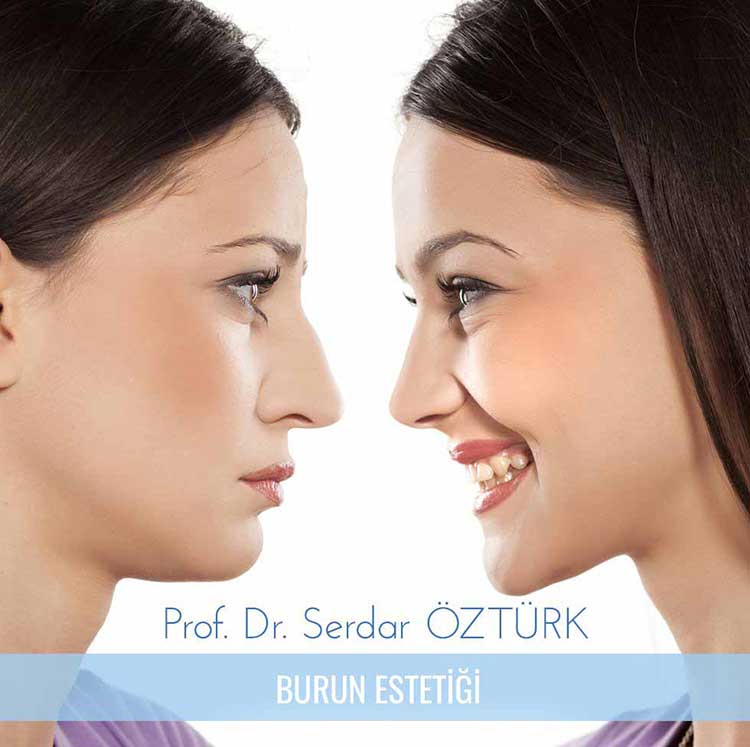
Rhinoplasty is an individually planned operation on the nasal dorsum, tip, bones and nostrils, aiming for a natural-looking nose that suits the face and breathes well. It is usually performed under general anaesthesia; most bruising settles within two weeks, while the final shape can take 6–12 months. In Ankara, assessment is by in-person consultation at Prof. Dr. Serdar Öztürk’s practice in Çukurambar.
What is rhinoplasty and what can it change?
Rhinoplasty is not a single manoeuvre but a set of surgical steps on the bone, cartilage and soft tissue of the nose, combined according to each patient’s needs. One patient may need only a dorsal hump reduced; another may need tip support, septal correction and repositioning of the nasal bones.
- Nasal dorsum: reducing a dorsal hump and smoothing the profile line.
- Nasal tip: refining and supporting a wide, drooping or asymmetric nasal tip.
- Nasal bones: narrowing wide bones or straightening a crooked nose.
- Length and angles: adjusting nasal length and the nose–lip angle to the proportions of the face.
- Nostrils: narrowing wide alar bases and reducing nostril asymmetry.
- Internal structures: correcting a deviated septum or enlarged turbinates in the same operation.
Rhinoplasty does not always make the nose smaller. The goal is a nose in balance with the face, not simply a small nose.
Who is a suitable candidate?
Adults who are unhappy with the appearance of their nose, have a structural breathing problem or whose nose changed after an injury may be assessed. Key criteria for a suitable candidate are completed facial growth, good general health, realistic expectations and a decision made freely, without pressure from others. Patients under 18 need parental consent. There is no upper age limit, but skin quality and general health are assessed more closely in older patients. Planning the right timing around school, work and season is also part of the consultation.
The consultation in Ankara
The consultation is the foundation of the surgical plan. It usually covers facial analysis and symmetry, skin thickness (thick skin limits refinement and swells for longer), cartilage support, an internal nasal examination and your medical history, including previous surgery, injuries, allergies and medication.
It helps to write down what you would like to change and to bring details of any previous nasal surgery. Computer imaging can help discuss expectations, but it does not predict healing or guarantee a result. You do not need to decide on the day. Guidance on choosing a rhinoplasty surgeon in Ankara is available separately.
Appearance and breathing together
Every change to the shape of the nose can affect the airway, so breathing complaints are assessed together with the aesthetic plan. The most common structural causes of obstruction are a deviated septum, enlarged turbinates and collapse of the nasal sidewalls. When these are corrected together with the shape, the operation is called septorhinoplasty. Not every blocked nose needs surgery: allergy and mucosal swelling are treated medically first.
Techniques: open or closed, piezo, cartilage grafts
Technique is a tool for reaching the plan, not a goal in itself. The open approach adds a small incision across the columella and gives direct access to the structures; the closed approach keeps incisions inside the nose. Bones may be shaped with rasps, osteotomes or ultrasonic (piezo) instruments; small humps may only need rasping. Septal, ear or rib cartilage may be used to support the tip and dorsum. No single technique is “best” for every nose; analysis, planning and follow-up determine the result.
Before surgery and the day of surgery
Preparation includes blood tests, an anaesthetic assessment, instructions about blood-thinning medication and supplements, and stopping smoking as early as possible. Rhinoplasty is usually performed under general anaesthesia in a fully equipped operating theatre; its length depends on the steps involved. Most patients go home the same day or the next day. A splint is placed on the nose, and internal silicone splints or packing are used only when needed. Bruising and swelling around the eyes, a feeling of pressure and temporary congestion are expected in the first days.
Recovery timeline
| Period | What usually happens |
|---|---|
| Days 1–3 | Swelling and bruising peak; rest with the head raised and use cold compresses. |
| Week 1 | The splint and stitches are usually removed; the nose may look upturned and swollen. |
| Week 2 | Most bruising fades; many people return to desk work or school. |
| Month 1 | Daily life is largely back to normal; light exercise with your surgeon’s approval. |
| Month 3 | Most swelling has settled; heavy and contact sports need separate approval. |
| Months 6–12 | The last tip swelling resolves; with thick skin or revision this may take longer. |
More detail is in the swelling and recovery timeline and recovery after rhinoplasty guides. Your surgeon’s written instructions always come first.
Risks, cost and travelling to Ankara
Risks include bleeding, infection, anaesthetic problems, prolonged swelling, irregularity or asymmetry, breathing difficulty and the need for a minor revision; see rhinoplasty risks. The cost cannot be given accurately before a consultation; it depends on the extent of surgery, grafts, hospital and anaesthetic fees (what affects the cost).
Patients from other cities or abroad can start by sending front, side and base photographs on WhatsApp for a preliminary review; the final plan is made at an in-person consultation. Staying in Ankara for about a week, until the splint is removed, is usually advised. See travelling to Ankara for rhinoplasty.
Prof. Dr. Serdar Öztürk and the Çukurambar practice
Prof. Dr. Serdar Öztürk graduated from Gülhane Military Medical Academy (GATA) in 1990 and became a specialist in Plastic, Reconstructive and Aesthetic Surgery in 1997. He became associate professor in 2006 and professor in 2012, and was head of the GATA Department of Plastic, Aesthetic and Reconstructive Surgery between 2012 and 2016. In 2003–2004 he worked in research and clinical practice at the University of Texas Southwestern Medical Center (Dallas, USA). The practice is in Çukurambar, Çankaya, Ankara; consultations are by appointment via the contact page or WhatsApp on +90 532 464 67 81.
Frequently asked questions
Does rhinoplasty always make the nose smaller?
No. The plan may also support the tip, correct the dorsum or balance proportions. The aim is a nose in harmony with the face.
How long does rhinoplasty take?
It depends on the steps involved. Septal correction, cartilage grafts or revision surgery take longer; the expected duration is discussed at consultation.
When can I return to work?
Most people with desk jobs return within one to two weeks. Physical work and sport need longer.
When is the final result visible?
Most swelling settles in the first months, but the last tip swelling can take 6–12 months, longer with thick skin or revision.
Is rhinoplasty the same as septoplasty?
No. Rhinoplasty changes the external shape; septoplasty straightens the internal partition. Combined, the operation is called septorhinoplasty.
Is computer imaging a guarantee?
No. Imaging helps discuss expectations but does not predict healing or the final result.
How do I book a consultation in Ankara?
Call or message +90 532 464 67 81 on WhatsApp. If you live abroad, you can start with a photo-based preliminary review.
Sources and further reading
General information resources; individual advice requires an examination.
American Society of Plastic Surgeons · Rhinoplasty ↗ASPS · Risks and safety ↗NHS · Rhinoplasty ↗This page is general information and does not replace an individual examination. Surgery has risks and outcomes cannot be guaranteed.