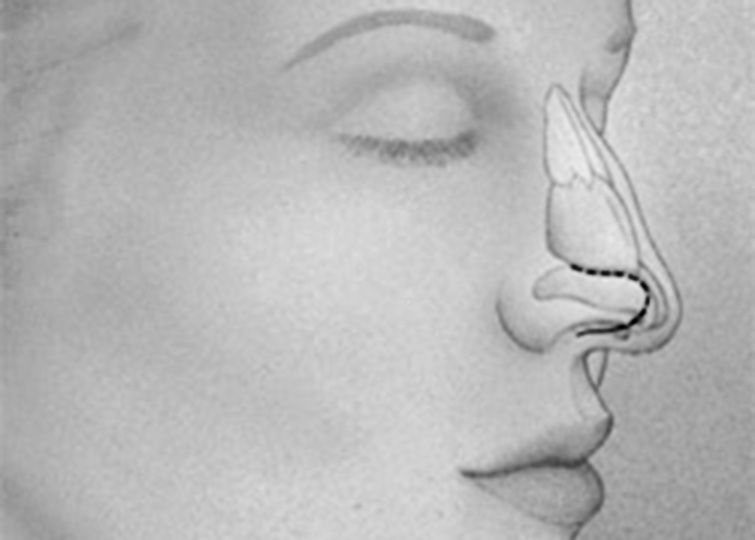
In closed rhinoplasty all incisions are inside the nose and there is no external scar. Open rhinoplasty adds a small incision across the columella (the strip between the nostrils), giving direct view of the tip cartilages. Neither is superior for everyone; the choice depends on tip work, graft needs and previous surgery.
Closed rhinoplasty
All incisions are made inside the nostrils. Hump reduction, narrowing of the nasal bones and limited tip changes can be done this way, with no visible scar and more limited dissection. Direct visualisation of the tip cartilages is more restricted, so complex tip work or extensive grafting may not be suitable.
Open rhinoplasty
A few-millimetre incision is added across the columella and the skin is lifted, allowing the cartilages and support structures to be seen, measured and shaped directly. The columellar scar usually fades well, although visibility depends on skin and healing. Tip swelling may last somewhat longer.
Key differences
A general overview; your own situation is assessed at consultation:
- Incision: closed — inside only; open — plus a small columellar incision.
- View: open allows direct visualisation; closed access is more limited.
- Tip work: extensive tip shaping and grafts usually favour the open approach.
- Swelling: tip swelling may last longer after open surgery.
- Revision: loss of support often requires an open approach.
Which nose suits which approach?
A patient with good tip structure whose main concern is a dorsal hump may suit a closed approach. Marked tip width, droop or asymmetry, extensive septal correction in a crooked nose or revision surgery often benefit from the control of an open approach.
Recovery
In both approaches expect a splint, swelling and bruising in the first week; the splint is usually removed after about a week, together with columellar stitches in open surgery. Most bruising fades within two weeks; the final shape takes months, longer with thick skin.
Frequently asked questions
Is open or closed rhinoplasty better?
Neither is better for everyone; tip needs, grafts and previous surgery determine the choice.
Does open rhinoplasty leave a scar?
A small columellar scar remains, which usually becomes inconspicuous over time.
Does closed rhinoplasty swell less?
Tip swelling may resolve sooner in some patients, but swelling varies between individuals.
Can revision be done closed?
Limited corrections may be; revisions with loss of support usually need an open approach.
How is the approach decided in Ankara?
At the consultation in Çukurambar the inside and outside of the nose are examined and the reasons for the recommended approach are explained.
Sources and further reading
General information resources; individual advice requires an examination.
American Society of Plastic Surgeons · Rhinoplasty ↗ASPS · Risks and safety ↗NHS · Rhinoplasty ↗This page is general information and does not replace an individual examination. Surgery has risks and outcomes cannot be guaranteed.