Which is your nose type?

We can collect the deformities in the nose that we frequently see in rhinoplasty under the following headings. These can be found in different combinations in a person.
Nose aesthetics is an operation in which mostly reduction and sometimes enlargement procedures are performed in combination.
Armed Nose:

Ethnically, it is the nose shape that we see most in our country, especially in the Black Sea region. When viewed from the profile, the curvature on the back of the nose is much more obvious. It consists of cartilage and bone structure. The size of the arch varies and the tip of the nose is downward due to the arch.
Low Tip of the Nose:
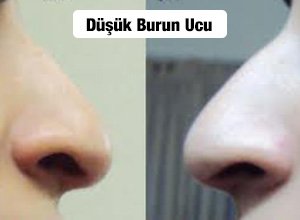
The angle between the tip of the nose and the lip is around 100-110 degrees in women and 90-100 degrees in men. Below this angle, the tip of the nose becomes low and needs to be lifted to bring it to the ideal angle. Above this angle, the nostrils appear frontally, which is undesirable. It is called piglet’s nose.
Nose Tip Wide:

The large size of the cartilage structure that forms the tip of the nose causes the tip of the nose to appear wide and bulky. The structure of this cartilage is extremely important in the shape and angle of the tip of the nose.
Narrow Tip of the Nose :

It causes the nasal tip cartilage to appear narrow structurally or after a previous surgery.
Pointed Long Nose Tip (Pinocchio Nose)

The nose tip is narrow and the nasal tip cartilages are large towards the front, creating the Pinocchio nose.
Long Nose :
We evaluate nose length according to the distance from the root of the nose to the tip of the nose. Structurally, it is especially seen in large-arched noses.
Short Nose :

Contrary to a long nose, a short nose may occur in people with structurally small nasal bones or after previous surgery (removing too much of the nasal septum cartilage)
Crooked Nose :

In the frontal view, it may be curved to the right or left or in a C or S shape relative to the midline of the face, either structurally or generally after trauma.
Nose Base Wide :

There may be width at the bottom side, depending on the size of the nostrils or the structure of the cartilage that forms the tip of the nose. It is more common in black and Far Eastern race.
Nose Projection Too Tight Nose :
It is a condition in which the nose is too far forward compared to the face plan. It may occur in large-arched noses, depending on the cartilages that form the tip of the nose.
Nose Projection is Enough you :
According to the face plan, the exact opposite is the case where the nose is left behind.
Broad Nose :
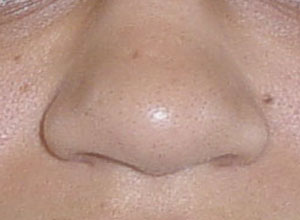
The wideness of the area we call the dorsum of the nose when viewed from the front may be due to the structural condition of the bone and cartilage structures that make up this area or may be traumatically wide.
Narrow Nose :

Unlike the wide nose, the dorsum of the nose is narrow, almost like a line.
Deep Nose Angle :
The root of the nose is quite deep

Nose Forehead Angle Straight :
The starting point of the nose is unclear, it is almost like a continuation of the forehead.
Saddle Nose :

The term “boxer nose” usually occurs as a result of excess cartilage being removed after trauma or during nasal bone curvature surgery.